Applying Rigid Registrations
Dragonfly's feature-based rigid registration workflows can automatically register datasets by applying the scaling, rotations, and translations required to match features between two datasets.
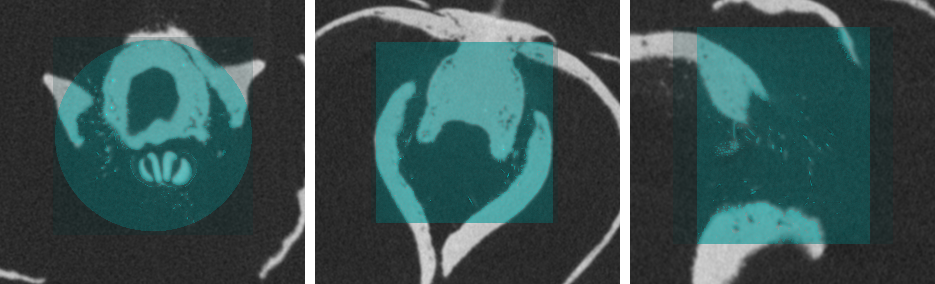
As shown in the example below, a high-resolution scan of an orchid flower's column (shown in cyan) was registered automatically with the full FOV (field-of-view) scan using the 'Mutual information' registration method.
High and low resolution images registered shown in multiple orientations
Two matching processes — Mutual information and SSD (sum of squared differences) — are available for registering datasets. You should note that these methods to quantify the degree of similarity between images and apply the required linear transformations are based on different concepts and that results may differ significantly. The performance of each algorithm is also dependent on the input data and the mode — Basic or Advanced — selected for registration.
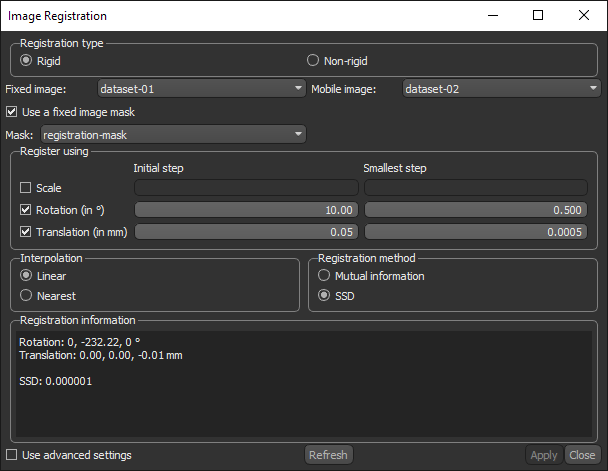
Image Registration dialog
| Description | |
|---|---|
| Registration type | Lets you choose a registration type — Rigid or Non-rigid. |
| Images |
Lets you select the a fixed image and the image that you need to register.
Fixed image… Is the baseline dataset and will not be modified during the registration process. Mobile image… Is the dataset that will be registered with the baseline. You should note that you can register multiple datasets with the baseline, as well as change the baseline. |
| Use a fixed mask | If selected, calculations for the required transformations will be constrained to the region defined by the selected mask (see Creating Mask ROIs). In other words, pixels outside the mask will not be considered when the required transformations are computed and the registration score is estimated. Fixed masks can be any region of interest that overlaps with the Fixed (stationary) dataset. |
| Register using |
Allows you to select the transformations that will be allowed during the registration process, as well as an Initial step and Smallest step for each selected parameter.
Scale… If selected, independent scaling in the X and Y dimensions in the lattice coordinate system of the selected mobile dataset may be applied to the mobile dataset. In some cases, scaling may have to be done independently of translation and rotation for best results. Rotation… If selected, rotations may be applied to the mobile dataset. Translation… If selected, translations may be applied to the mobile dataset. Note The estimate of the scale, rotation, and translation initial steps should be approximate to the observed displacement. |
| Interpolation |
Allows you to select the type of interpolation that will be applied to the mobile dataset during the registration process.
Nearest… Is the most basic interpolation scheme and only considers one pixel when filtering. Linear… Considers the closest 2 x 2 neighborhood and then takes a weighted average of the four pixels to arrive at a final interpolated value. Usually results in smoother looking images than Nearest. |
| Registration method |
Allows you to select a matching process — either Mutual information or SSD.
Mutual information… Mutual information is a basic concept from information theory that can be applied in the context of image registration to measure the amount of information that one image contains about another. Image registration by maximization of mutual information considers all voxels in the images to be registered to estimate the statistical dependence between corresponding voxel intensities. The registration criteria postulates that mutual information is maximal when the images are correctly aligned. You should note that the criterion is histogram based rather than intensity based, does not impose limiting assumptions on the specific nature of the relationship between corresponding voxel intensities, and is shading independent. Refer to the following for more information: Medical Image Registration Using Mutual Information, Frederik Maes, Dirk Maes, and Paul Suetens. Proceedings of the IEEE, Vol. 91, No. 10, 2003. SSD… In the SSD (sum of squared differences) matching process, differences are squared and aggregated within a square window and later optimized by a winner-take-all strategy. This measure has a higher computational complexity compared to sum of absolute differences (SAD) algorithms as it involves numerous multiplication operations, but can produce superior results. You should note that the sum of squared differences method is commonly used for registering image data of the same modality. |
| Registration information |
Provides information about the transformations that were applied to the selected dataset and the registration score estimate.
You should note that a registration score approaching 2.0 indicates a good match for mutual information, while scores approaching 0 indicate goods matches for the sum of squared differences. |
| Use advanced settings | Provides additional options. When using the Advanced settings, you can select the Initial step and Smallest step that will be applied to each axis of the mobile dataset. |
| Refresh | Updates the current registration score. For example, after changing the mobile dataset, fixed mask, or registration method. |
| Undo | Undoes the current registration. |
| Apply | Automatically registers the selected mobile dataset with the baseline. |
 How to Apply a Rigid Registration
- Open the required datasets.
- Do the following, as required:
- Align the centroid of the datasets that you plan to register with each other, recommended (see Align).
- Apply an initial manual registration (see Registering Images Manually), recommended.
This can help accelerate the automatic registration process.
- Create a fixed mask, which can be any region of interest that overlaps with the Fixed (stationary) dataset, optional (see Regions of Interest).
If a fixed mask is used, calculations for the required transformations will be constrained to the region defined by the selected mask.
- Right-click the dataset that will be used as the Fixed dataset , or baseline, in the Data Properties and Settings panel and then choose Image Registration in the pop-up menu.
The Dataset Registration dialog appears.
- Choose the dataset that will be used as the baseline in the Fixed dataset drop-down menu.
This dataset will not be modified during the registration process.
- Choose the dataset that will be registered with the baseline in the Mobile dataset drop-down menu.
- Select the Use a fixed mask option, if required, and then choose a mask in the Mask drop-down menu.
- Select the transformations that will be allowed — Scale, Rotation and/or Translation — as well as an Initial step and Smallest step for each selected parameter.
Note If you are using the Advanced settings, you can select an Initial step and Smallest step for each axis of the mobile dataset.
- Select an interpolation method — Linear or Nearest — in the Interpolation box.
- Choose a registration method — Mutual Information or SSD — in the Registration method box.
- Click the Apply button to automatically register the datasets.
- Evaluate the results.
If required, you can modify the selected parameters and then update the registration by clicking the Apply button again. You can also click the Undo button to undo the current registration.
- Save the applied changes, if required.
See Exporting and Saving Data for information about saving registered image data.